
WELCOME BONUS 300%
UP TO €2000 + 100
FREE SPINS
UP TO €2000 + 100
FREE SPINS
Home → Blackjack
Blackjack at Supercasino: Variants, Rules and Payouts
Perfect Pairs vs 21+3 in House Edge
The Perfect Pairs side bet in Blackjack has a house edge of 4.00% (based on 6 decks, S17, DAS, DOA, 3:2 payout). This means players can expect to lose 4.00% of their wagers over the long term.
In contrast, the 21+3 side bet, often found on Infinite Blackjack tables, carries a house edge of 3.07% (based on an average of typical payouts). This demonstrates a lower expected loss for players engaging with this particular side bet.
For players seeking to minimise the house edge on side bets, the 21+3 option presents a marginally more favourable scenario than Perfect Pairs. This difference can impact overall player return, especially with frequent play on mobile devices.
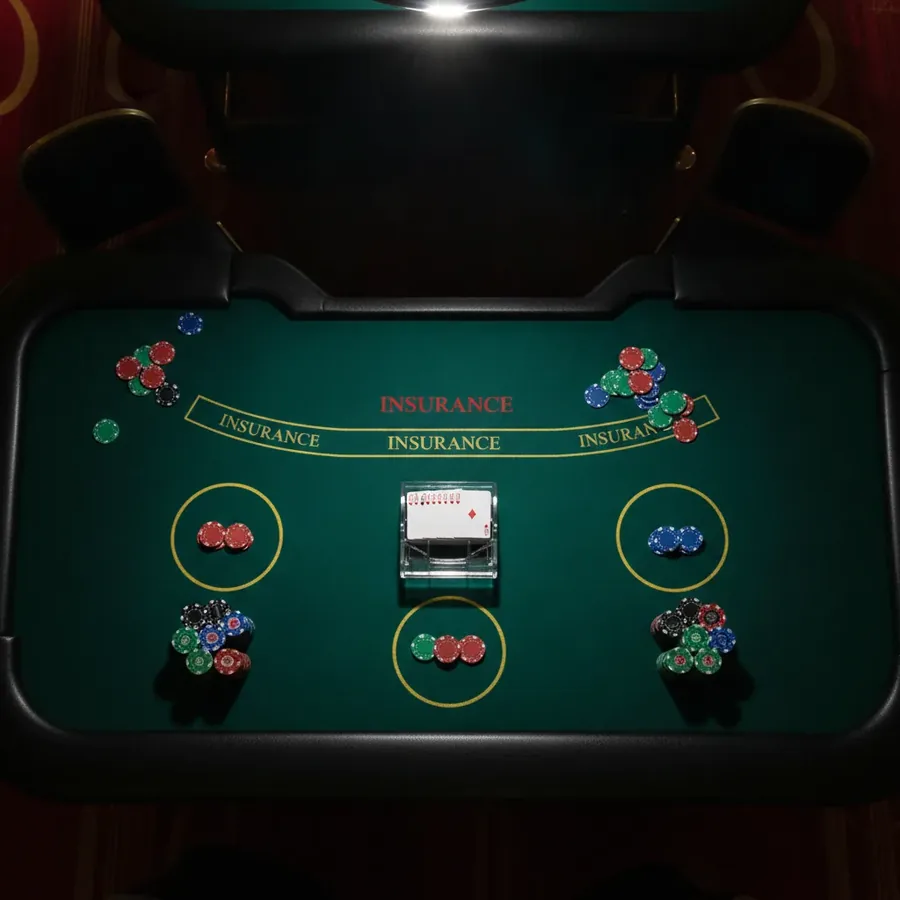
Insurance Pays 2:1 Yet Still Costs Money
Blackjack Insurance, offered on many tables including those accessible via mobile, presents an RTP of 92.53% for 6-8 decks. This side bet allows players to wager up to 50% of their main bet against the dealer having a blackjack.
The house edge for Insurance stands at a considerable 7.47%, making it a less favourable proposition than the main game, which can have a house edge as low as 0.15% with a single deck and classic rules. Basic strategy advises always declining this bet unless card counting is employed.
Despite paying out at 2:1, the high house edge means that over time, players making the Insurance bet can expect to lose a significant portion of their funds, a factor to consider during mobile gaming sessions.
Which hands are excluded from Surrender?
Blackjack Surrender, a feature available on some variants, allows players to forfeit half their stake after the dealer checks for blackjack. This option can improve RTP by approximately 0.08 percentage points compared to not having it.
While Late Surrender is a common feature, Early Surrender is significantly more beneficial, potentially reducing the house edge by up to 0.6 percentage points, but it is extremely rare in online and mobile blackjack offerings.
The specific hands excluded from surrender are not detailed in the provided data, but the general rule is that players can surrender after the dealer's initial two cards are dealt and they have checked for blackjack. This rule is often applied to hands the player deems very weak.
Which rule variants does the software show?
Supercasino's software includes Blackjack Split / Double / H17 variants, where the house edge is affected by several rule modifiers. For instance, the dealer hitting on a soft 17 (H17) increases the house edge by 0.22 percentage points.
Conversely, rules like Resplit Aces (RSA) and Double After Split (DAS) are beneficial to the player, reducing the house edge by approximately 0.08 and 0.14 percentage points respectively. These rule differences are observable across various online blackjack games.
The number of decks used also impacts the house edge; playing with 6 decks instead of 8 typically reduces the edge by about 0.02 percentage points. Understanding these rule variations is key to selecting the most favourable games for mobile play.
When does the table max bet apply?
Live Lightning Blackjack, available on the platform, features a bet range from 1 to 2,500 EUR per hand, accommodating a high maximum wager for players. This game also offers unlimited players and multipliers up to 25x on winning hands.
Infinite Blackjack and Quantum Blackjack Plus Live allow for even higher stakes, with a table maximum bet of 5,000 EUR. These live dealer games, provided by Evolution and Playtech respectively, are accessible on mobile devices.
The stated table maximum bet applies per hand, irrespective of the number of players at the table, ensuring a consistent betting limit for all participants engaging in these live blackjack variants.
Blackjack variants at a glance
| Variant | Payout | House edge | Rule | Bet range |
|---|---|---|---|---|
| Blackjack 6 Decks, S17, DAS, DOA, Auszahlung 3:2, Basisstrategie | 99.54% | 0.46% | Dealer steht auf Soft 17; Verdopplung auf jeder Zweierkarte; Verdopplung nach Split erlaubt; keine Aufgabe. Basisstrategie ist für diesen Wert zwingend | Blackjack 3:2, normaler Gewinn 1:1, Insurance 2:1 |
| Blackjack Split / Double / H17 – Regel-Effekte | n.a. (Regel-Modifikatoren) | H17 +0.22 Prozentpunkte; RSA −0.08 Prozentpunkte; DAS −0.14 Prozentpunkte | Dealer Hits Soft 17 verschlechtert RTP um 0.22 Prozentpunkte; Resplit Aces verbessert um 0.08 Prozentpunkte; Double After Split verbessert um ca. 0.14 Prozentpunkte; 6 Decks statt 8 – ca. 0.02 Prozentpunkte. | Double – Einsatz ×2 mit einer Karte; Split – bis 4 Hände; Ass-Split meist mit einer Karte. |
| Blackjack Insurance / Versicherung (6–8 Decks) | 92.53% | 7.47% | Separate Nebenwette bis 50% der Hauptwette, wenn der Dealer ein Ass hat. Basisstrategie schreibt IMMER Ablehnung vor (außer Karten zählen bei True Count ≥ +3). Bei einem Deck Vorteil ≈ 5.88% | Insurance 2:1 |
| Blackjack Liberal Vegas Strip (liberale Regeln, 3:2) | 99.72% | 0.28% | Günstigste Regelkombination: S17 + DAS + Resplit + Late Surrender. Standardabweichung 1,15 | Blackjack 3:2, Gewinn 1:1 |
| Blackjack Surrender (Late Surrender) – Regel-Effekt | n.a. (Regel-Modifikator) | −0.08 Prozentpunkte | Spieler gibt Hand nach Dealer-Blackjack-Prüfung auf, verliert die Hälfte des Einsatzes. Verbessert RTP um ca. 0.08 Prozentpunkte. Early Surrender ist wesentlich wertvoller (bis −0.6 Prozentpunkte), aber extrem selten. | Rückzahlung 50% des Einsatzes |
| Blackjack Auszahlung 6:5 statt 3:2 (6 Decks) | 98.15% | 1.85% | Ersatz von 3:2 durch 6:5 fügt exakt +1.39 Prozentpunkte zum Vorteil des Casinos hinzu – stärker als jede andere Regeländerung. Bei $10 Einsatz zahlt Blackjack $12 statt $15. | Blackjack 6:5, Gewinn 1:1 |
Soft Hand and Hard Hand Practically Distinguished
A soft hand in blackjack is one that contains an Ace, which can be counted as either 1 or 11. For example, an Ace and a 6 form a soft 17. This flexibility is crucial for strategy, as it prevents busting when hitting. The ability to adjust the Ace's value is a core mechanic differentiating soft from hard hands.
Conversely, a hard hand is one without an Ace, or where the Ace must be counted as 1 to avoid busting. If a player has a 10 and a 7, this is a hard 17. Hitting on a hard 17, for instance, carries a significant risk of exceeding 21. Understanding this distinction is fundamental for applying optimal blackjack strategy.
Blackjack games with specific rules, such as 'Dealer Stands on Soft 17' (S17), offer a lower house edge of 0.46% compared to games where the dealer hits soft 17 (H17), which increases the house edge by approximately 0.22 percentage points. This rule directly impacts decisions made with soft hands.
Live stream with three cameras and OCR
Live dealer blackjack at Supercasino features technologies like Optical Character Recognition (OCR) and multiple camera angles, enhancing the player experience. Games like Evolution's Lightning Blackjack, with RTPs of 99.56%, offer dynamic gameplay. The use of OCR ensures accurate game state recognition and transparent betting.
Infinite Blackjack, also from Evolution, provides an unlimited number of player seats and a RTP of 99.47%. It also includes four side bets: Any Pair, 21+3, Hot 3, and Bust It. This variety allows players to engage with the game in different ways, all streamed with professional dealers and multiple camera views.
Playtech's Quantum Blackjack Plus Live offers a RTP of 99.57% and features Quantum multipliers up to 1,000x on three-card 21s. The advanced streaming technology, including multiple cameras, allows players to follow the action closely, creating an immersive environment comparable to a physical casino.
Four hours of play with 300 EUR bankroll
Playing blackjack for four hours with a 300 EUR bankroll requires careful management, especially considering the house edge. A game with a 0.46% house edge, like Blackjack 6 Decks, S17, DAS, DOA, with a 3:2 payout, offers better longevity than a 6:5 payout game (1.85% house edge).
The choice of game significantly impacts how long a 300 EUR bankroll can last. For instance, playing Blackjack Ein Deck with classic rules and 3:2 payout (0.15% house edge) is more forgiving than a game with a higher house advantage. A session of four hours at a 10 EUR per hand bet would involve 240 hands.
With a 300 EUR bankroll and betting 10 EUR per hand, approximately 30 hands can be played before the bankroll is depleted if all hands lose. However, considering average RTPs and potential wins, a four-hour session is feasible with disciplined betting and favourable outcomes, particularly in games like Blackjack Liberal Vegas Strip (0.28% house edge).
Splitting costs double bet: plan budget
Splitting in blackjack, a move allowed by rules such as DAS (Double After Split), effectively doubles the initial bet for that hand. For example, if a player splits a pair of Aces and bets an additional 10 EUR on each, the total wager for that turn becomes 20 EUR, plus the original bet.
Games with favourable splitting rules, like DAS, improve the player's RTP. While splitting increases the immediate wager, it can lead to better outcomes. For a 300 EUR bankroll, a player betting 10 EUR per hand might need to adjust their budget if they frequently split pairs, as this requires more capital per round.
The cost of splitting is a direct increase in the bet amount per hand. For instance, if a player decides to split a pair and places a new bet of equal value on the second hand, their total outlay for that round increases. This is a key consideration for bankroll management, particularly in games that permit splitting up to 4 hands.
What doesn't count towards turnover at 10 percent?
When a welcome bonus of 300% up to €2,000 plus 100 free spins is claimed, understanding wagering contributions is crucial. At Supercasino, table games, including blackjack variants, typically contribute only 10% towards the bonus turnover requirement. This means that for every 10 EUR wagered on blackjack, only 1 EUR counts towards the wagering.
The 10% contribution from table games means that a significant amount needs to be wagered to clear the bonus. For example, to meet a wagering requirement of 4,000 EUR (calculated as 100 EUR bonus x 40 wagering requirement), a player would need to wager 40,000 EUR on blackjack, as only 10% of each bet counts.
Side bets in live dealer blackjack, such as those in Infinite Blackjack (Any Pair, 21+3, Hot 3, Bust It), may not contribute to the bonus turnover at all, or at a different rate than main bets. It is important to verify the exact contribution rates for all game types to effectively manage bonus wagering. Slots, conversely, usually contribute 100%.
How long do 100 EUR last at a 1 EUR table?
At a 1 EUR table, 100 EUR could theoretically last for 100 hands if every hand was a push. However, considering a house edge of 0.28% for Blackjack Liberal Vegas Strip, the average session would be shorter. This house edge means that, on average, 0.28 EUR of every 100 EUR wagered is retained by the casino over the long term. Therefore, a player's 100 EUR would likely deplete faster than 100 hands played.
When playing Blackjack Liberal Vegas Strip, which has an RTP of 99.72%, the expected loss per 100 EUR wagered is 0.28 EUR. This rate of attrition implies that a 100 EUR bankroll would, on average, support approximately 357 hands before being exhausted (100 EUR / 0.28 EUR per 100 EUR wagered * 100 hands). This calculation does not account for variance, meaning actual results can differ significantly.
The duration of 100 EUR at a 1 EUR table is influenced by the chosen game's RTP and the player's betting strategy. For instance, if the RTP was 98.15% (as with Blackjack Auszahlung 6:5 statt 3:2), the expected loss per 100 EUR wagered increases to 1.85 EUR. This higher house edge would reduce the average number of hands playable from the 100 EUR bankroll significantly.
Surrender vs Playing Out on 16 vs 10
The Blackjack Surrender rule, specifically Late Surrender, allows a player to forfeit half their bet after the dealer checks for blackjack. This rule modifier improves the RTP by approximately 0.08 percent points. When faced with a hard 16 against the dealer's 10, surrendering is often the mathematically optimal play according to basic strategy.
Playing out a hard 16 against a dealer's 10 without the surrender option typically leads to a worse outcome compared to surrendering. The Blackjack Liberal Vegas Strip, with a house advantage of 0.28%, assumes players make optimal decisions. In this specific scenario, the act of surrendering conserves capital by reducing potential losses, which is a key tenet of managing funds.
While Late Surrender offers a small RTP improvement of about 0.08 percent points, it is less impactful than Early Surrender, which can reduce the house edge by up to 0.6 percent points but is extremely rare. For a player with 100 EUR, choosing to surrender on a 16 vs 10 could save an average of 0.08 EUR per 100 EUR wagered on that hand, contributing to longer playtime.
Shoe, Cut Card, and 75 Percent Penetration
The number of decks used in blackjack significantly impacts the house edge, with fewer decks generally favouring the player. For example, Blackjack Ein Deck, klassische Regeln, 3:2 offers an RTP of 99.85%, a 0.15% house edge, which is approximately 0.48 percent points lower than an 8-deck game. Shoe games typically use multiple decks to make card counting more difficult.
Penetration refers to how deep into the shoe the dealer plays before reshuffling. 75 percent penetration means that three-quarters of the cards in the shoe are played before reshuffling. This level of penetration in a 6-deck shoe, for instance, leaves a substantial portion of the cards remaining, potentially affecting the odds for players who track card composition.
A 75 percent penetration in a 6-deck shoe game, where the house edge is 0.46% (Blackjack 6 Decks, S17, DAS, DOA, Auszahlung 3:2), means that approximately 4.5 decks are played before reshuffling. This depth allows for more distribution of favourable and unfavourable cards to be dealt, impacting the strategic decisions available to players, such as doubling down or splitting.
Side Bets don't count towards bonus turnover
Players aiming to clear bonus wagering requirements should be aware that side bets often do not contribute to this turnover. For instance, the 300% welcome bonus up to €2,000 plus 100 free spins requires specific conditions to be met. The general rule is that table games contribute 10%, while slots contribute 100% towards bonus wagering.
Side bets such as those found on Infinite Blackjack, which include Any Pair, 21+3, Hot 3, and Bust It, are separate wagers from the main game. If a player has a 4,000 EUR wagering requirement from a bonus (e.g., €1,000 bonus x 40 wagering), and they place 10 EUR on the '21+3' side bet, this 10 EUR will not count towards the 4,000 EUR target.
Consequently, focusing solely on side bets when trying to meet bonus terms will not fulfil the requirements. For example, wagering 100 EUR on side bets would contribute 0 EUR to the wagering requirement, whereas wagering 100 EUR on slots would contribute 100 EUR. This distinction is critical for players to maximise the value of their bonuses.
Splitting tens costs expected value: better stand
Splitting a pair of tens is generally considered a suboptimal play in blackjack, as it reduces the player's expected value. A strong starting hand like two tens, totalling 20, is a very powerful position. The Blackjack Liberal Vegas Strip, with an RTP of 99.72%, rewards strategic play, and splitting tens deviates from this.
The expected value calculation for blackjack demonstrates that standing on 20 offers the highest probability of winning against most dealer upcards. For example, a 20 has a significantly higher win rate than two separate hands starting with 10 each. The house advantage of 0.28% in this variant is predicated on players adhering to basic strategy, which advises against splitting tens.
Splitting tens would mean breaking a hand with a high chance of winning into two new hands, each starting with a value of 10. This action typically results in lower overall expected winnings compared to keeping the original 20. Therefore, for players aiming to maximise their RTP and minimise the house edge, standing on 20 is the recommended approach.
Contact
Live - online chat
Banking









Providers












Supercasino 2026